POLICY ON INCREASING THE NUMBER OF ARTICLES PUBLISHED IN CR JOURNAL
2026-06-08

Creative Research Journal (CR Journal) has been a platform for scientific research dissemination, focusing on West Java's developmental challenges. Managed by the Regional Research and Development Agency (BP2D) of West Java Province since 2015.
During the period of 2021-2022 CR Journal was attacked by system malware. Fortunately, since early 2024 CR Journal already recovery steadily then comprehensive published in the Online Journal System (OJS) since Volume 10 No 01 June 2024. Fully information about it, attached on the official statement document.
CR Journal biannual publication (June and December) accepts article types in the form of scientific papers. In a move to support open access, CR Journal implements a no-fee policy for published articles.
Submission to CR Journal requires online registration and login. Authors can track their submissions through the online system. Only electronically submitted articles via the online portal are considered; all others are automatically rejected. For submission-related queries, the Editorial Office can be reached at [email protected].
All scientific articles that send to CR Journal have to meet our rules that already declare in our guidance book. The editorial process begins with an Initial Review by the Editor, examining language, scope alignment, originality, and plagiarism. Turnitin software is employed to ensure content originality. Articles passing this stage proceed to a Double-blind Full Review, conducted by at least two peer reviewers.
Post-review, authors receive feedback for revisions. Reviewers assess both substantial and technical aspects of the articles. The Editor-in-Chief, considering all evaluations, makes the final publication decision. Accepted articles undergo a final proofreading phase involving both the Editor and the Author.
CR Journal prioritizes confidentiality in all aspects of the review process. The Editorial Team ensures author anonymity during the review phase, and all reviewer decisions are based on objective criteria.
For reference, CR Journal's International Standard Serial Numbers (ISSN) are:
ISSN: 2460-4194 (print)
ISSN: 2579-9231 (online)
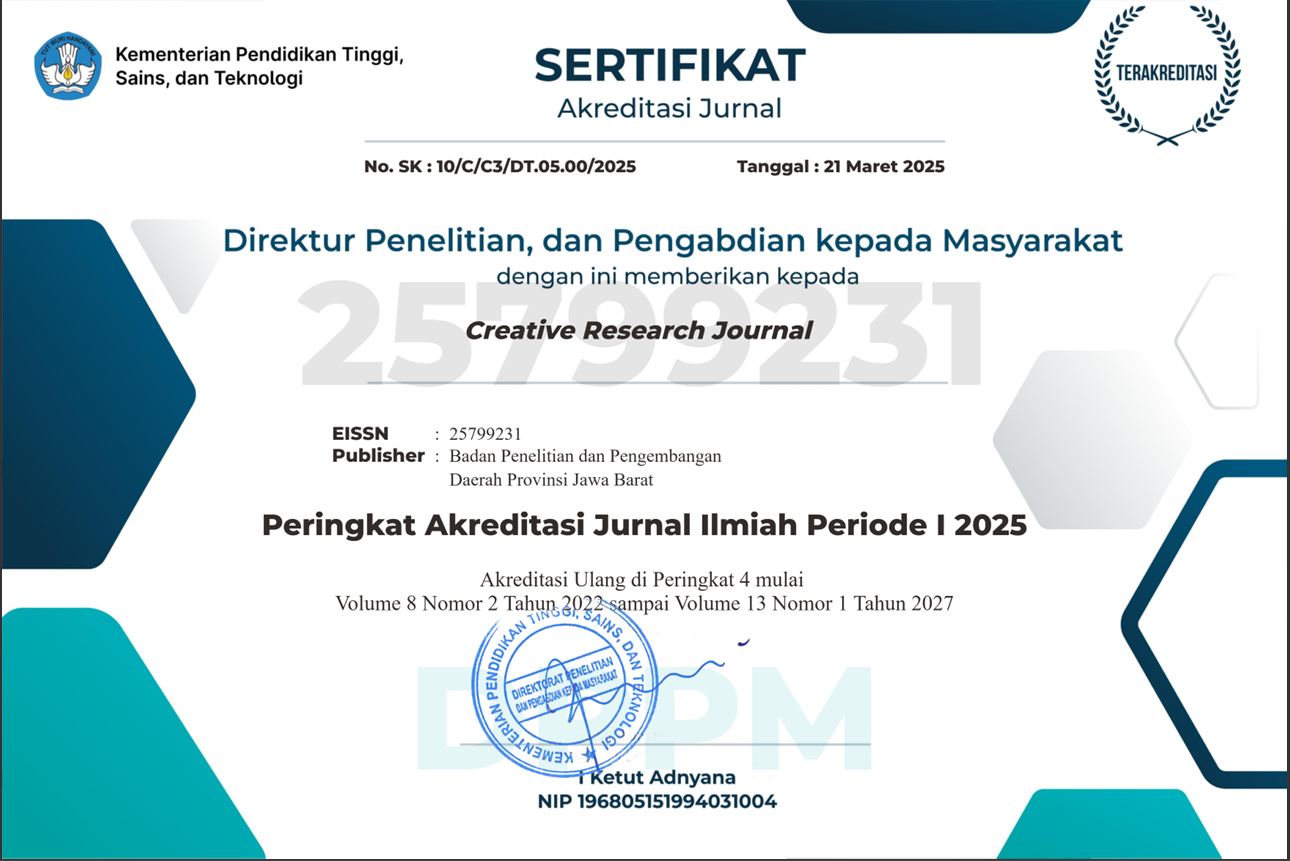
CR Journal is accredited SINTA 4/S4 for 5 years (2022-2027) based on Ministry of Higher Education, Research and Technology of The Republic of Indonesia (No SK. 10/C/C3/DT.05.00/2025). The journal has been indexs in Google Scholar, Crossref, and others international indexing.
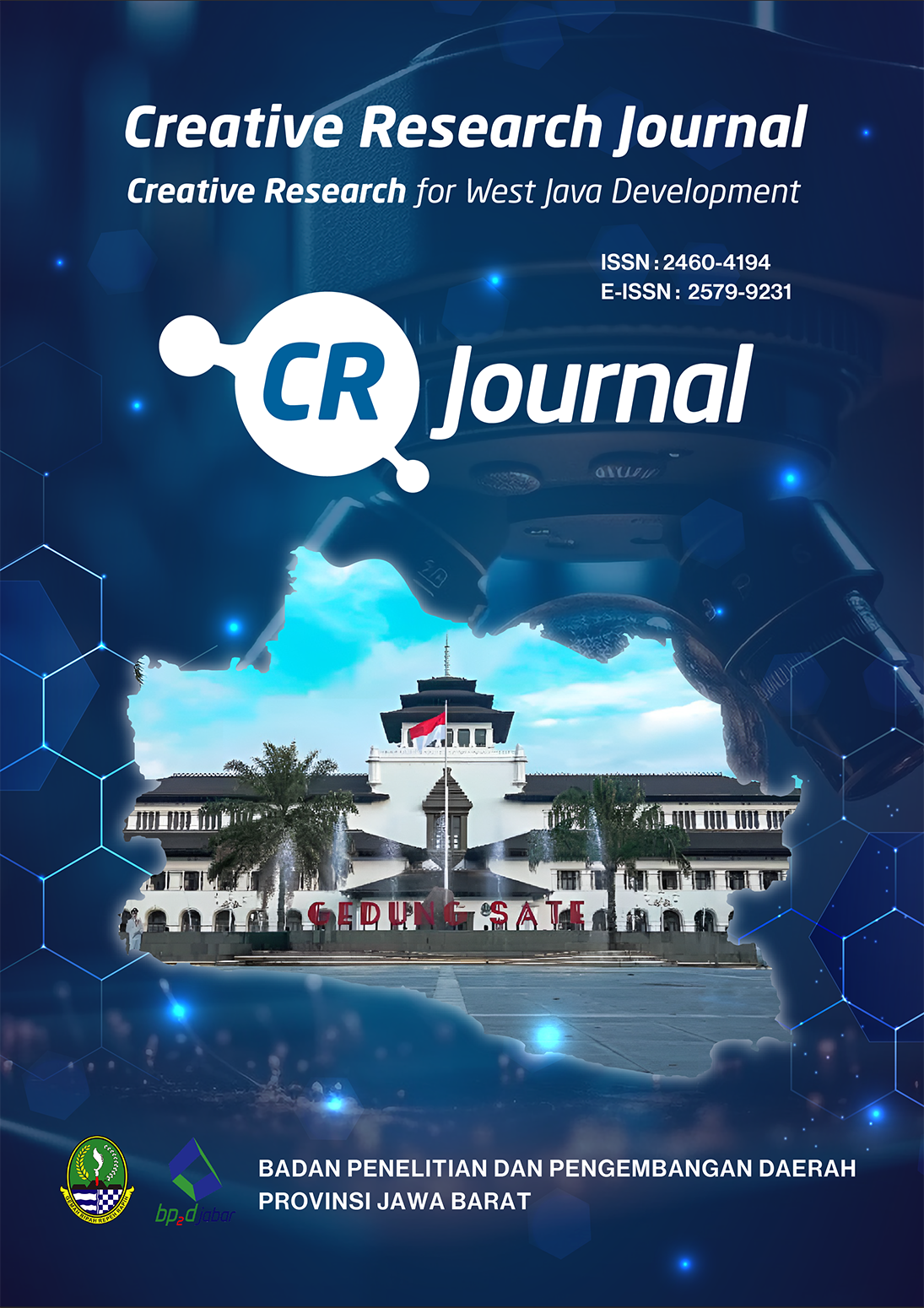
CR Journal Vol. 12 No. 01 June 2026 comprises seven articles covering various sectors with the following titles: (1) Education and Economic Paradox: Analysis of Determinants of Female Labor Force Participation in West Java (2020-2024); (2) Behind Capital Flows: Examining ff Foreign Direct Investment (FDI) and Domestic Direct Investment (DDI) Impacts on Unemployment in West Java; (3) Spatial Analysis of Village-Level Prevalence of Undernourishment in Sukabumi Regency; (4) Tourism Development Strategy of Kujang Sapasang Tower and Al Kamil Mosque in The Jatigede Area Using an Integrated Approach; (5) Structuring The Area Around Soreang–Pasirkoja Toll Gate; (6) Modeling Urban Structure and Activity Through The Clockboard Zoning Approach: A Case Study of Cekungan Bandung Area and (7) Analysis of Spreading and Backwash Effect Patterns in Exploring Growth Pole Theory (Case Study: Bandung Basin Urban Area)
In the first article, the results reveal an educational paradox where RLS has a significant negative effect on female participation (-5.196), indicating a "discouraged worker" effect or high selectivity among educated women. Conversely, economic growth (PDRB) positively drives participation (19.665), while the minimum wage (UMK) shows no significant impact. These findings suggest that creating formal sector jobs that match higher education levels is crucial for West Java's development. Then, the second article show that DDI has a significant negative effect on the OUR, indicating its role in labor absorption. Conversely, FDI has a significant positive effect, implying its capital-intensive nature and potential skill mismatch. Economic growth is proven to significantly reduce the OUR, while HDI paradoxically shows a positive effect. The main conclusion is that not all investments impact the labor market equally. The policy implication is a needed shift from investment quantity to quality, prioritizing labor-intensive domestic investments and aligning human resource development with industry needs.
In the third article, the findings indicate a Moran’s Index value of 0.50, demonstrating a significant spatial clustering of PoU, with hotspot areas concentrated in the northwestern and southern regions. The correlation analysis produced a coefficient of –0.38, suggesting a negative association between PoU and IDM. Hotspot patterns in developed and independent villages were predominantly located in the southern region. These results underscore the presence of interregional linkages associated with elevated PoU levels in Sukabumi Regency and highlight the need for more targeted development policies, particularly those aimed at strengthening food security through improved governance to enhance human capital quality. Next, the fourth article, findings show that the Kujang Sapasang Tower and Al Kamil Mosque have advantages in terms of cultural and architectural uniqueness and institutional support, but on the other hand, they have weaknesses and threats that could shift their existence if no strategic steps are taken by the Sumedang Regency Government as the main manager. Based on the analysis results, it is evident that transformative efforts are needed to enhance the development of the Jatigede tourism destination, particularly the Kujang Sapasang Tower and Al Kamil Mosque.
In the fifth article, the findings indicate that the area can be organised through a three-zone segmentation strategy—gateway zone, core corridor, and supporting corridor—supported by design parameters such as regulated building setback lines, a minimum 4-meter inclusive pedestrian pathway, strengthened streetscape elements, and the integration of informal activities through a spatio-temporal approach. This concept promotes the live, work, and play principle and reinforces comfort and image attributes to enhance public space quality and strengthen the area’s identity as the gateway to the capital of Bandung Regency. The study provides an operational basis for preparing urban design guidelines and integrating growth control mechanisms into local spatial planning documents. Then, the sixth article show the maximum NDBI value reaches 0.552 and is concentrated in the metropolitan core, while the basin-scale average NDBI remains negative, reflecting the dominance of non-built-up areas. The highest NTL intensity was observed in Bandung City, with an average of 29.56 nW/cm²·sr and a density of 117.67/km², followed by a sharp decline toward peripheral areas. Bivariate NDBI–NTL classification across 45 clockboard zones is dominated by Transition and Dominant Developing Sectors, while the Core Sector accounts for only 26.67% of zones, indicating a polycentric, asymmetric, corridor-based metropolitan growth pattern. Last, the seventh article, demonstrates that the dominance of Bandung City as the core triggers a backwash effect that weakens the hinterland areas, specifically causing a decline in the economic ranking of Cimahi City and West Bandung Regency due to resource migration and the impact of the pandemic. These findings indicate a monopoly of the growth pole. Therefore, strategies to establish secondary growth centers and improve regional accessibility are required to promote a more balanced distribution of development.
Happy reading CR Journal Vol. 12 No. 01 June 2026, and may it be beneficial.
 Abstract views :
342 times
Abstract views :
342 times
 Downloaded :
430 times
Abstract views :
1189 times
Downloaded :
175 times
Abstract views :
119 times
Downloaded :
116 times
Abstract views :
72 times
Downloaded :
97 times
Abstract views :
1126 times
Downloaded :
88 times
Abstract views :
134 times
Downloaded :
104 times
Abstract views :
214 times
Downloaded :
191 times
Downloaded :
430 times
Abstract views :
1189 times
Downloaded :
175 times
Abstract views :
119 times
Downloaded :
116 times
Abstract views :
72 times
Downloaded :
97 times
Abstract views :
1126 times
Downloaded :
88 times
Abstract views :
134 times
Downloaded :
104 times
Abstract views :
214 times
Downloaded :
191 times